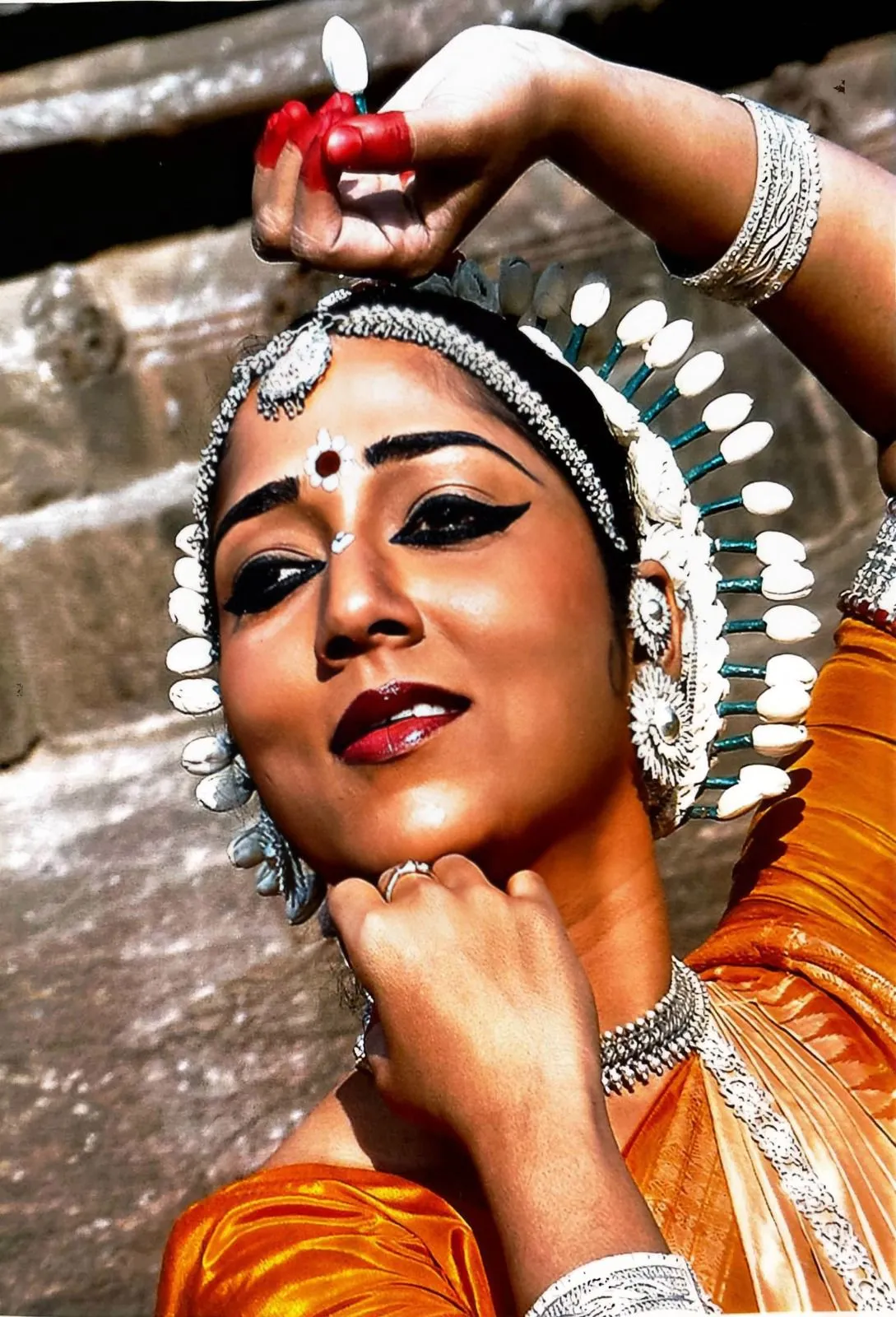
I was playing outside my home in Bhubaneswar, immersed in the small, self-sufficient world of childhood, when my uncle arrived with a gentleman. I remember looking up for a fleeting second—he was short, with curly hair, dressed in a white kurta and pyjama. There was nothing, at first glance, that told me he would change the course of my life.
They walked inside. I stayed back, chasing my game. Soon after, I was called in. Reluctantly. I was introduced to him—Guru Deba Prasad Das.
What does a four-year-old know of such introductions? Of destinies disguised as strangers? And yet, something about him made me pause. There was an inexplicable calmness, a warmth that invited trust. I found myself sitting beside him, my restlessness dissolving into quiet curiosity. He smiled often—a smile that reached his eyes and gently dismantled my hesitation.
After speaking for a while, he asked my parents to arrange for something. A kalash was brought and placed before us. There was a stillness in the room I could not understand. Then he tied a red thread around my wrist.
At that age, it meant nothing to me. Today, I know—it meant everything.
“That was the moment I was initiated into Odissi, though I remained blissfully unaware that I had just stepped onto a path that would stay with me through every turn of my life.”
Looking back now, it feels almost surreal. I was growing up under the guidance of a Guru who had already taken Odissi beyond the geographical and cultural boundaries of Odisha—who had travelled across the world, sharing its stories, its spirit, its soul. Through his dance, he carried Odisha to distant lands, inviting the world to witness its beauty.
But to me, he was simply Guruji. And he came home to teach me. There is something profoundly humbling about that. The same man who taught celebrated dancers across the globe would sit patiently with a child, repeating the basics, correcting the smallest of mistakes, ensuring that the foundation was strong.
There were rules. No ghunguroos until the feet learned clarity. No haste, no shortcuts.
When my feet hurt, when fatigue turned into complaints, he never dismissed them. Instead, he would ask me to sit beside him. And then, the classroom would transform—into stories. He would speak of lands far away, of people he had met, of food that seemed unimaginable to my young mind. I remember vividly the day he spoke of people in China eating cockroaches. I was horrified—I nearly gagged at the thought. Years later, when I was in Kuala Lumpur and my Chinese friends joked, "we eat anything with its back to the sun," I burst out laughing, transported instantly back to those afternoons beside him.
Those stories were lessons too—lessons in imagination, in listening, in seeing beyond one's own world.
There were days when Guruji would be away, and his senior students would come to teach me in his place. I dreaded those days. They were efficient, disciplined—but lacked the softness I had come to associate with learning. They expected precision without understanding that I was still a child trying to find joy in movement.
So, I waited. And when Guruji returned, I would rush to him, words tumbling over each other as I listed every complaint I had carefully stored. He would listen—always with that same calm attentiveness. Without my realizing it, he was shaping not just my dance, but my way of seeing.
His teaching had an extraordinary elasticity—it adapted itself to the student before him. Once, during a lesson on hasta mudras, I asked him, quite seriously, if mudras could show someone riding a helicopter. It was a child's question, born out of curiosity rather than relevance.
He did not dismiss it. Instead, he demonstrated it instantly—his left hand in byaghra, his right in suchi, circling in the air to mimic the blades. That was enough. For days, I became the proud inventor of a "helicopter mudra," zooming around and demonstrating it to anyone who would indulge me.
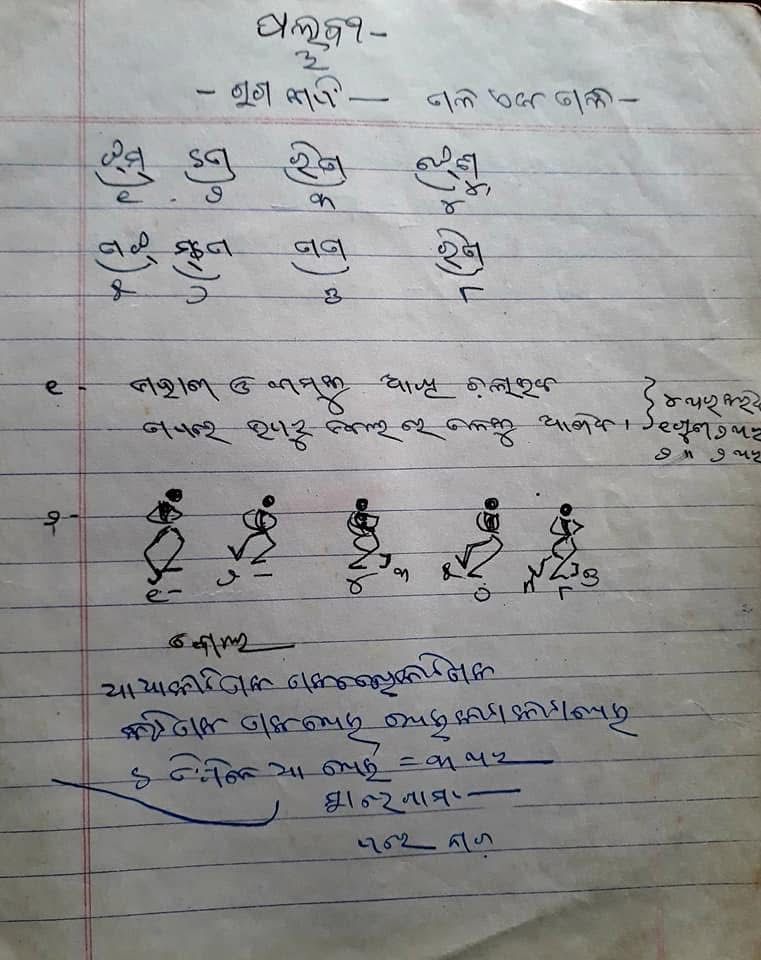
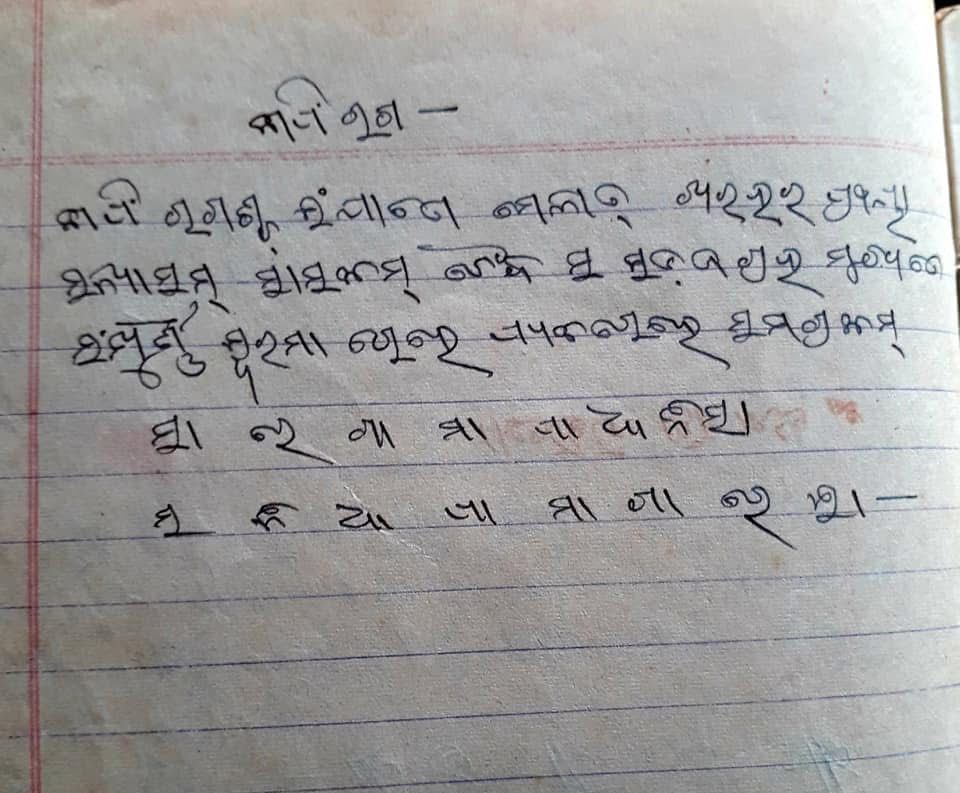
Another of his remarkable methods was his use of drawing. After teaching me a sequence, he would sit down and carefully sketch the steps in my notebook so I could remember them. Today, when I revisit those pages, I pause in quiet wonder. What moved him to spend so much time and care on a little child? Perhaps it was the sheer joy of teaching—the joy of passing on something he loved.
“The first piece he taught me was an invocation to Lord Ganesha. Through him, I began to understand that dance was not merely movement—it was meaning made visible.”
Then came performances. When my aunts suggested that I perform at their art school's annual showcase, Guruji agreed with a gentle smile. I had only learned the Mangalacharan, but he decided to teach me more. He chose "Ahe Nilagiri tumbha shri bhuje dayanaa keri keri…"
And suddenly, my imagination found direction. Through his words, Puri came alive before me—the Bada Danda, the temple, the devotees, the rhythm of devotion. The next time I visited Puri, I did not just see it—I felt it. And somewhere within that feeling, I began to dance instinctively.
As I grew, the lessons deepened. One of the most vivid memories I carry is of learning "Dekha Sahi Rahi Go…"—a piece that required shifting between characters, understanding layers of storytelling.
When it came to the demons, Guruji did not merely show movements—he narrated their existence. He sat beside me and began describing how each one was different. How Aghasura was not Bakaasura, how Bakaasura was not Trunabarta. Each had a distinct personality, a distinct energy, a distinct presence.
And then, he translated that into dance. I can still see him demonstrating Shakatāsura—his hands in suchi hasta, moving in circular patterns in the air, mimicking the rolling of a cart. It was so vivid that I did not need to imagine it—it was already alive before me.
Through him, I learned that dance was not imitation—it was embodiment. Each character had to be understood before it could be expressed. Each movement had to carry intention. That lesson stayed with me. Even today, when I approach choreography, I find myself returning to that space—of listening deeply, of analysing characters, of allowing movement to emerge organically rather than forcing it.
Later came the Dasa Avatar. And with it, a moment I now hold with immense reverence. To perform the Dasa Avatar at Baya Matha, following Balkrishna Das—the revered Sangeet Sudhakar, the doyen of Odissi music—was not just an opportunity, it was a blessing.
At that age, I may not have fully grasped its magnitude. But today, I understand. To dance in the presence of such greatness, to follow a legacy so profound—how fortunate I was. How quietly, how generously, life was placing me in spaces that would later define me.
Perhaps that is why, through every phase of my life—my education, my travels, my years in different countries—dance remained my constant. It was never just an art form. It was memory. It was companionship. It was a quiet thread connecting every version of me to that four-year-old child sitting beside her Guru.
They say that Father, Mother, and Guru are not accidental presences in one's life. They are destined—relationships that transcend a single lifetime.
When I think back to that day, to that red thread tied around my wrist, I no longer see it as a ritual I did not understand. I see it as a beginning. A quiet, sacred beginning. A moment where a child unknowingly stepped into a lifelong dialogue—with her Guru, with her art, and with herself.
And even today, in every movement I make, in every story I tell through dance, that thread continues to move with me.
Unbroken.