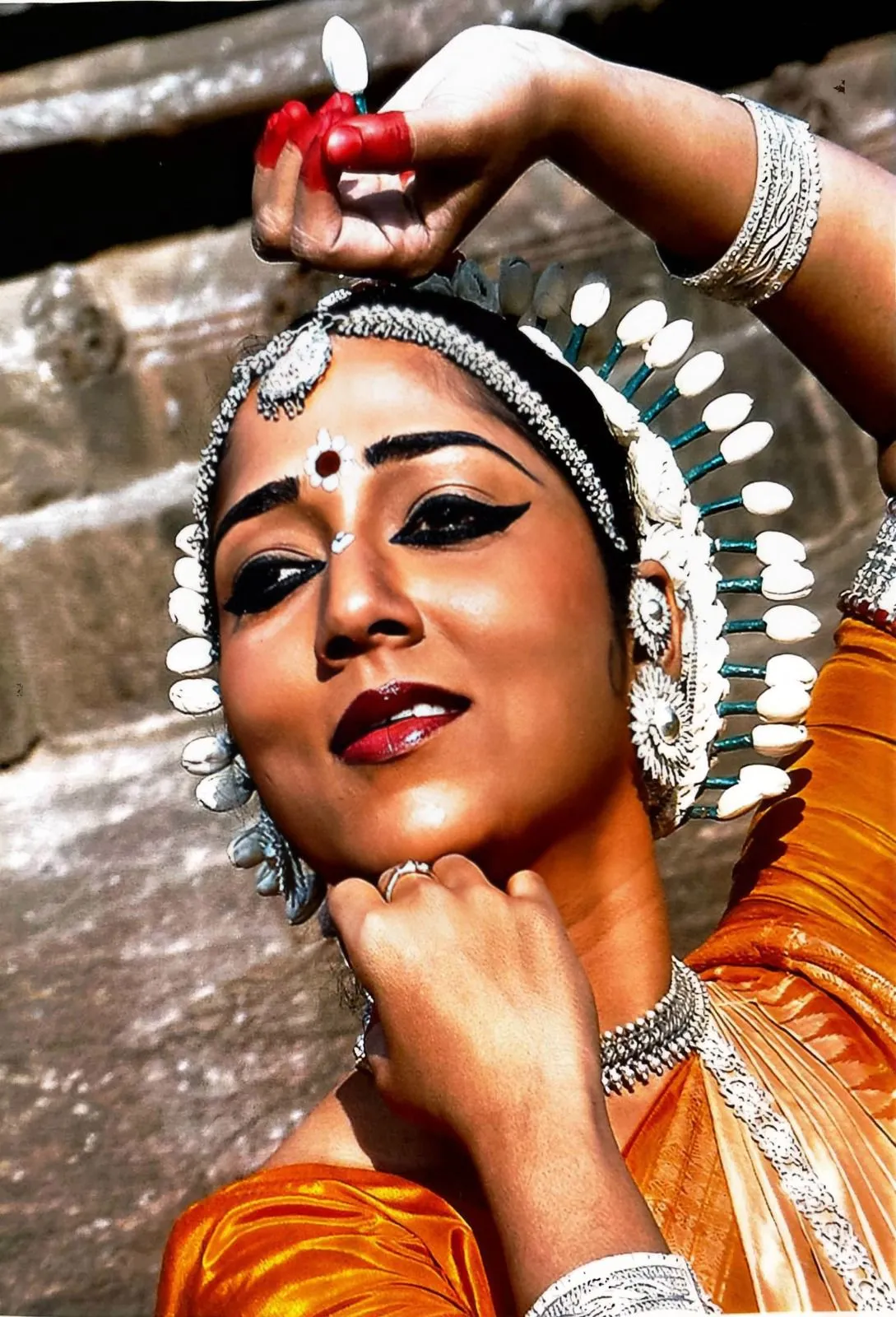
Under Vrindavan's Gentle Spell
There are some journeys that begin with planning, itineraries, and intention. And then there are journeys that begin almost invisibly — as if one is quietly summoned long before one understands why.
Our relationship with Vrindavan began that way.
In 1986, my father first took us there. Vrindavan was never an idea or philosophy for him — it was an experience of the heart. He carried it within him as something alive, intimate, and deeply loved. After creating Basanta Rasa as a full-length feature film, he felt an irresistible urge to journey deeper into Krishna-lila. My mother began writing dance dramas like Madhur Milan and Swapna Bilas — weaving together the divine worlds of Krishna, Radharani, and Chaitanya Mahaprabhu. Slowly, these lilas began to fill our home, our conversations, our rehearsals, and our travels.
These lilas breathed life into him because they were his life. And because we danced them together, all of us — the dancers, the musicians, the children growing up within that world — became part of his heart as well. He loved us more deeply because, through us, he felt Krishna's presence becoming tangible.
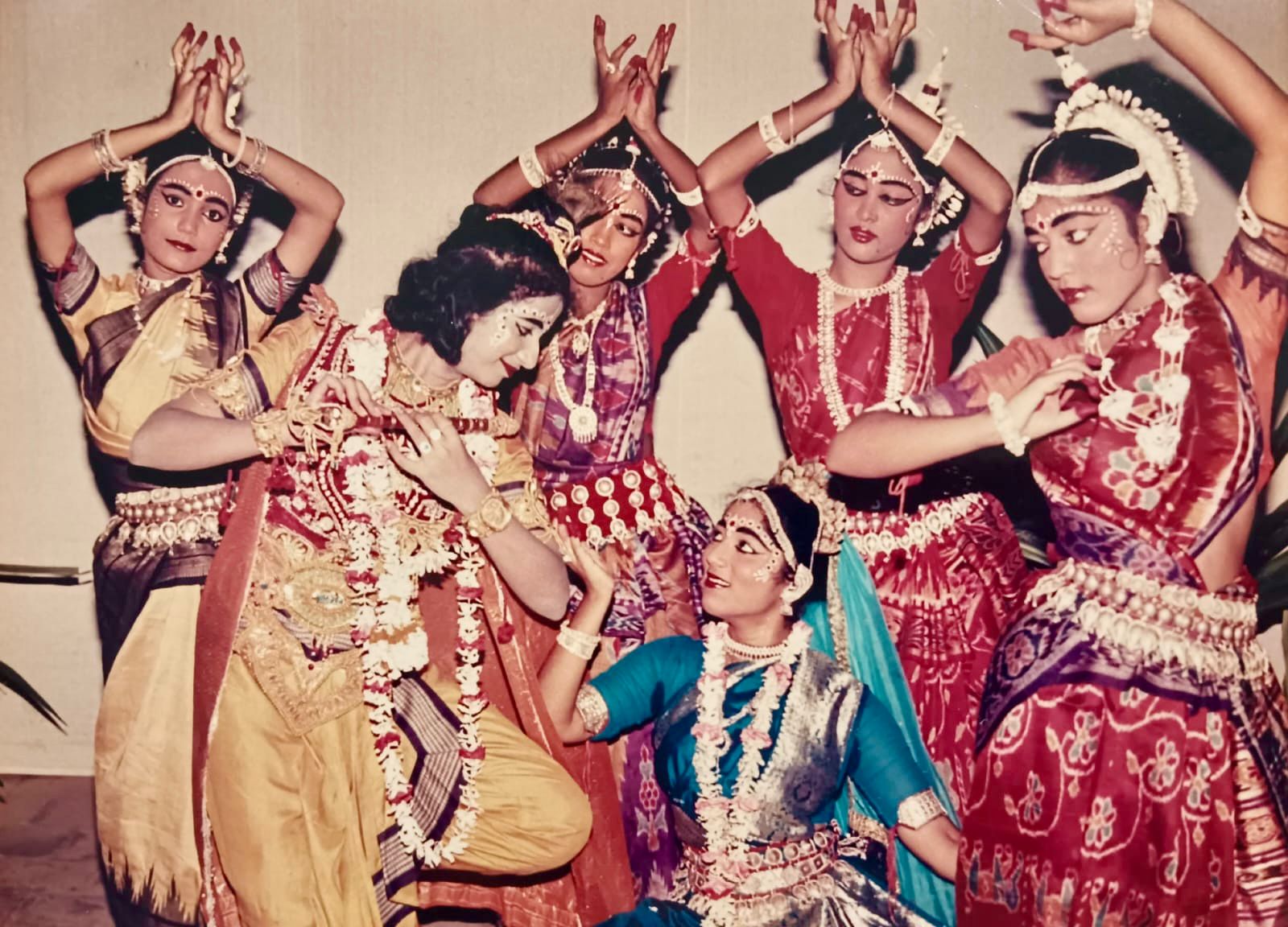
We travelled as "Team Bansi Bilash," carrying costumes, jewellery, recorded music, painted crowns, ankle bells, and the innocent excitement of dancers about to perform Krishna-lila before the Vaishnavas of Braj. At that time, we still thought of it as performance.
Vrindavan gently changed that understanding forever.
The moment we entered its lanes and groves, a quiet transformation unfolded within us. The stories we had rehearsed no longer felt enacted. It seemed as though the land itself already knew them — as though we had merely stepped into something eternally unfolding. And we realised that art was no longer separate from devotion.
The excitement began long before we arrived. The moment news spread that we were travelling to Vrindavan to perform, our dancers erupted with joy. Their families insisted on accompanying us. Relatives wanted to join. Devotees began visiting our home asking if they too could come along.
What began as a troupe slowly became a pilgrimage caravan. In the end, more than thirty of us boarded the old Utkal Express from Bhubaneswar — the only train then that halted at Mathura Junction. I still remember the restless thrill of that journey: sharing food everyone had brought from home, peering through barred windows as the train crossed fields, rivers, and dark tunnels, the smell of railway chai, endless conversations about Krishna and Braj, singing, and antakshari.
And then came Mathura. From there, we climbed into horse-drawn tongas for the ride to Vrindavan. To this day, that journey remains suspended in memory like a scene from another era. The horses moved briskly along uneven roads while fields stretched endlessly on both sides, green and wind-brushed beneath the fading sky. Dust rose softly behind the wheels. Temple spires appeared unexpectedly in the distance. Someone pointed toward Yamuna. Someone else began singing a bhajan.
And then, at last, we entered Vrindavan.
By the grace of Srimati Radharani, and through the kindness of the Goswamis and Brijvasis, we were given space in the courtyard of Radha Raman Temple. That first dawn remains etched in my senses.
Around four in the morning, temple bells rang through the darkness. Not loudly, but insistently — like a call one cannot ignore. Half asleep, wrapped in shawls against the chill, we followed the sound into the temple for mangal arati.
And there He was — Sri Radharaman Lal.
The tiny Shaligram deity who, by the loving wish of His devotee Sri Gopal Bhatta Goswami, revealed Himself in this exquisitely beautiful form — a vision so enchanting that one glimpse seemed enough to overwhelm the entire heart. I remember standing there unable to understand why tears came so easily to the devotees around me. Later I would understand: some places do not merely allow darshan. They undo you.
Our mornings soon found rhythm. Breakfast meant following my father through the lanes for hot kachodis and potato curry fragrant with hing. We wandered daily through Loi Bazaar, slowly learning the temperament of Vrindavan's famous monkeys. Nothing in your hand was safe — especially spectacles. One moment they were on your face, the next in the hands of a triumphant monkey perched overhead like a mischievous companion of Krishna Himself.
Afternoons often led us to the samadhi sthala of Sri Gopal Bhatta Goswami, where we first met Ghanashyam Baba — originally from Berhampur, yet completely belonging to Vrindavan. With him, one never felt like a guest. He cared for everyone with such affection that it felt as though Nanda Maharaj himself had adopted us.
The prasad there felt unforgettable. And at the end came what we all secretly waited for — cool chaas served in earthen pots. Every day someone or another brought sweets: peda, laddoo, kheer. Vrindavan fed not only the stomach. It overwhelmed the heart.
It was during those days that we also met Vishnupriya Didi, who slowly became family. She too had come from Berhampur to Vrindavan as a child. Every evening after our performances, she would arrive carrying prasad for us with such affection and warmth that we never noticed when friendship quietly transformed into lifelong belonging.
Even today, whenever Vrindavan calls us again, she remains one of the reasons it still feels like home. She helped us move between temples, saints, books, bhajans, rehearsals, and performances. She would sing to us the lores of Braj and tell us about the lives of its saints — tales of sadhus who spoke to Krishna as naturally as one speaks to a friend. Snatches of songs by Haridas Goswami and Nagari Das Baba. Stories of Radharani whispered not from scriptures, but as lived memory.
The Brijvasis themselves changed us most deeply. Elsewhere, audiences watched. In Vrindavan, they participated.
For them, Krishna is not merely a deity to be worshipped from afar. They love Him through relationship: as a son to be cared for, a friend to laugh with, a master to serve. The Gopis are not symbolic figures. The lilas still move invisibly through the groves and temple courtyards. And when we danced, their silence held a kind of attention fuller than applause. It felt as though they were witnessing remembrance.
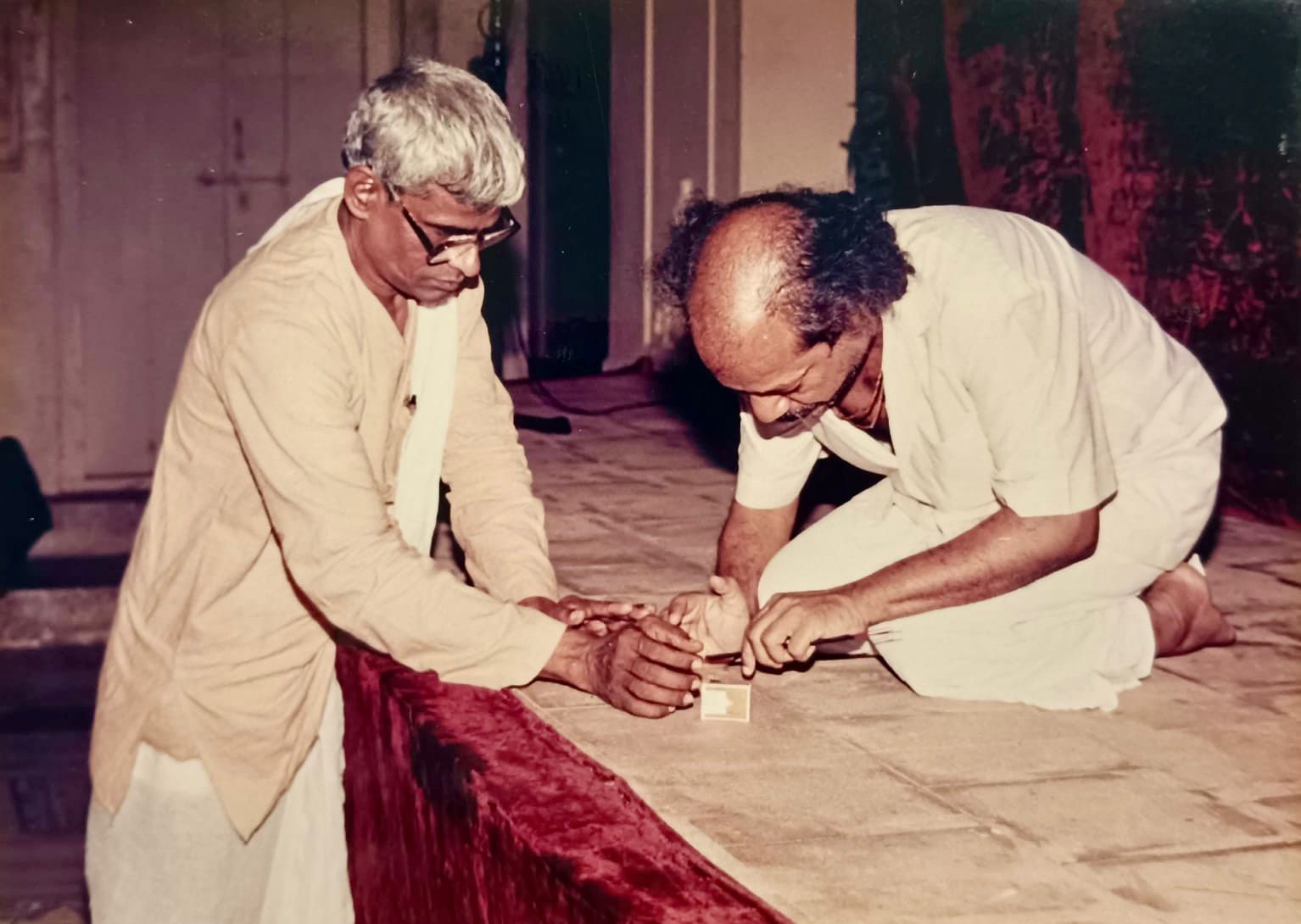
Our first performance in Vrindavan was at Kishor Van, the sacred grove associated with the revered saint Sri Hari Ram Vyas and his deity, Yugal Kishor. The very next day, we were to perform at Sri Govind Dev Ji Temple.
We were quietly finishing our make-up when sudden news reached us: we would not be permitted to perform before the deity of Sri Govind Dev Ji.
The reason was simple.
"How can anyone portray Sri Krishna in the direct presence of Govind Dev Ji Himself?"
My father was devastated. To him, these dance dramas were never entertainment. They were offerings. Without hesitation, he went personally to speak with the temple priest. After a long and heartfelt discussion, permission was finally granted — but on one condition: the dancer portraying Krishna must appear without the flute and without the peacock feather. I still remember my father returning with visible relief.
That evening, surrounded by Brijvasis and Vaishnavas, we performed Madhur Milan and Swapna Bilas before Govind Dev Ji Temple. A deep stillness seemed to settle over the gathering, as though everyone present had forgotten themselves entirely.
And afterward, something unexpected happened.
The priest suggested that we should also offer this lila before Sri Govind Dev Ji in Jaipur, where the original deity had been moved centuries earlier during the Mughal invasions. My father needed no convincing. The very next morning, he hired a bus and took the entire troupe to Jaipur.
A grand dance festival was underway there, with celebrated artistes performing on magnificent stages. There was no stage free and we were ushered inside the temple to offer our lila. It was a space right infront of Sri Radha Gobind Dev ji, the natamandapa, and we danced with everything we had.
And afterward, standing near the altar of Sri Govind Dev Ji, my father suddenly began singing through tears:
Naba re Naba re Naba Nabaghana Shyama
Tomari piriti khani ati anupama...
His voice trembled with emotion. Later he told us that, in that moment, he felt as though Govind Dev Ji Himself had gathered all of us into His embrace.
Some memories never age. They continue glowing quietly inside you.
Year after year we returned to Vrindavan with new dance dramas — Nimai Sanyas, Sharad Raas, Sri Krishna Balya Lila. With each visit, our bonds deepened.
At Jayasingh Ghera, also known as Bhramara Ghat we were showered with affection by Sri Purushottam Goswami Maharaj and his son, Sri Sribatsa Goswami Maharaj. They told us that whenever we came to Vrindavan, we should stay with them and accept prasad there. And so Vrindavan slowly stopped feeling like a place we visited. It became extended family.
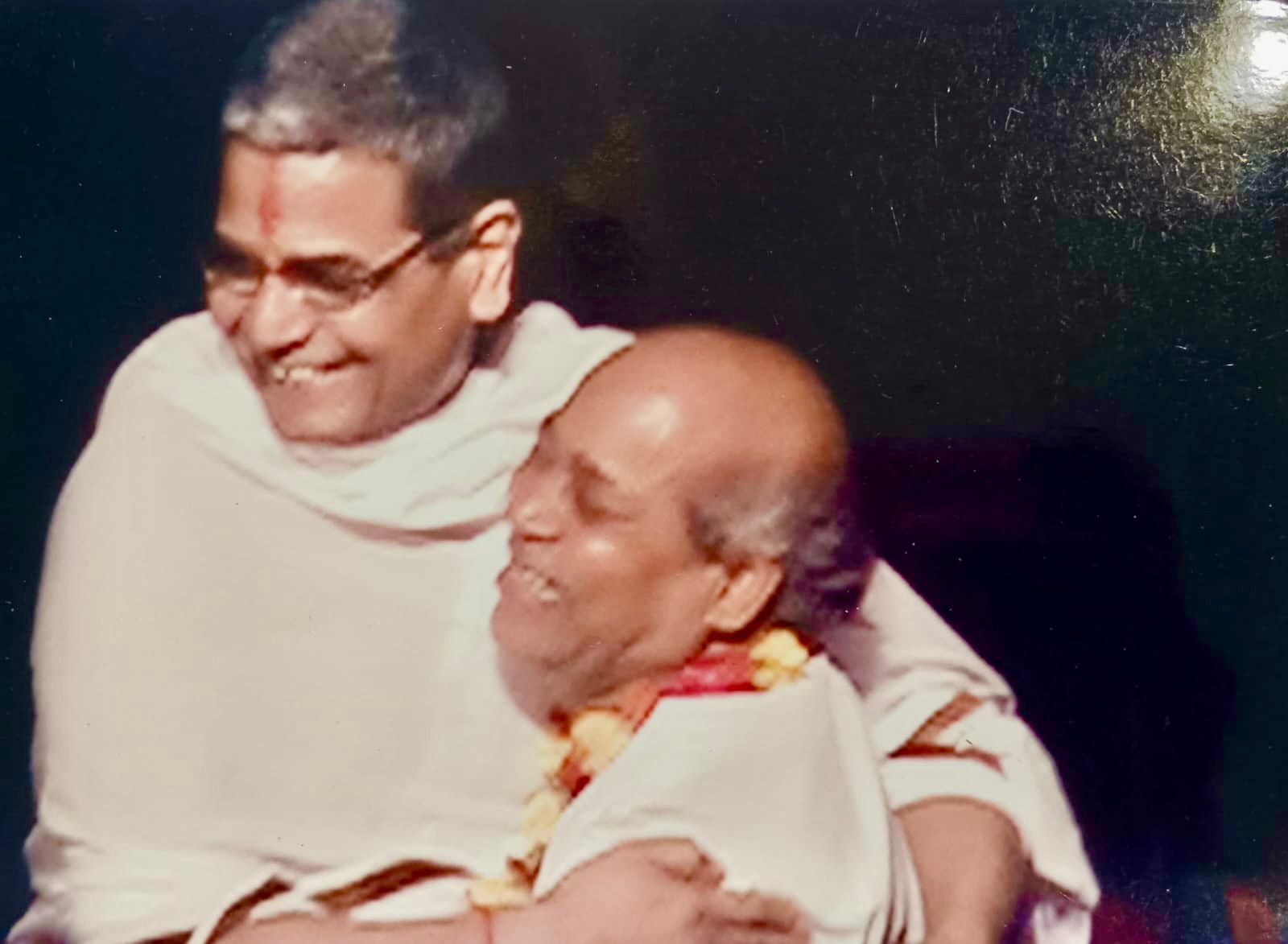
Once, after a performance at Jayasingh Ghera, the Vaishnavas requested that all of us performers remain on the stage. They said they wished to offer their obeisances to the 'Yugal Jodi'.
What followed left us utterly speechless. One by one, the devotees formed a line and slowly ascended the stage. With folded hands and tears in their eyes, they bowed at the feet of Radha and Krishna, offering pranami, money, and even jewellery with deep reverence and devotion.
Seeing this, my father immediately rushed towards the sadhus and pleaded with them, "Please do not do this. They are only children."
But the Vaishnavas replied gently, "This jhanki is of Shyamsundar and Radharani. They are Their swaroop."
We sat there stunned, unable to fully comprehend what we were witnessing. Never before in our lives had we encountered devotion expressed with such intensity and sincerity. For us, it felt as though the boundary between performance and divine presence had dissolved entirely.
Later, my father donated all the pranami to the organisation that had hosted us. Yet the experience itself remained with us — something beyond the ordinary, something that belonged to another world altogether.
I remember another night in Mathura when Sri Sripad Baba invited us to perform both Sri Krishna Balya Lila and Nimai Sanyas one after another because he was leaving town the next morning and wished to see both.
The challenge was immense.
Bimbadhar Sir — our beloved make-up artist — had barely an hour to transform the entire cast between productions. My sister, who had just portrayed Yashoda, now had to become Sachi Mata. Costumes flew. Paint rushed across faces. Jewellery changed hands frantically backstage.
And yet, when we emerged for the second performance, the audience was still seated. Nobody had left. Past midnight, they continued waiting. What thrilled us was not admiration, but their absorption. And when the performances ended, their blessings never felt ceremonial. It felt as though they were quietly telling us:
"Radharani has accepted your offering."
Then there was the unforgettable day we went for darshan of Sri Nagari Das Baba.
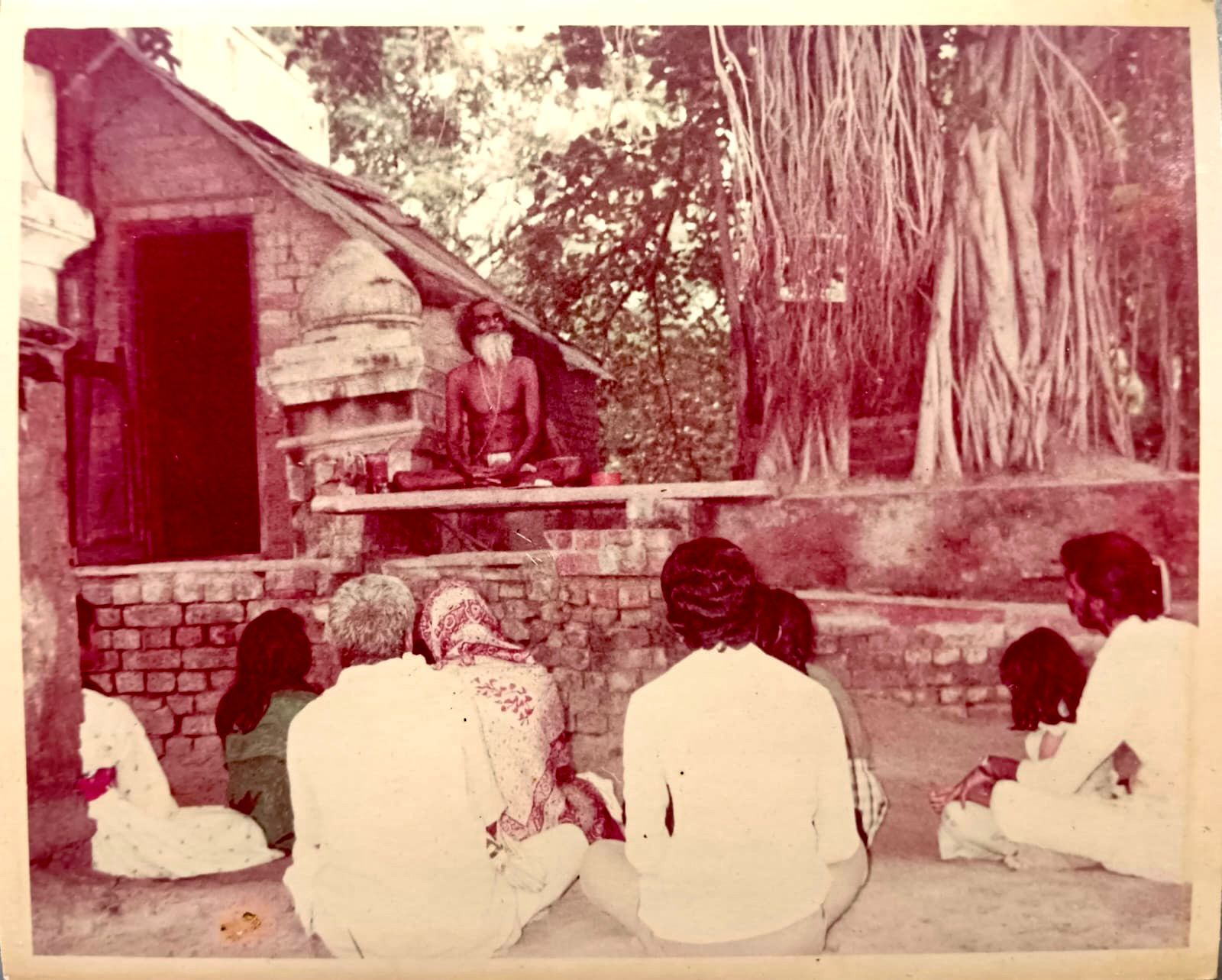
He sat near the banks of Yamuna, simple and radiant. Nearby, his beloved Krishna deity rested perched upon a tree. We sat before him while he spoke of Krishna, Radharani, and Vrindavan as though they stood there in front of him. I still remember the tenderness with which he fed his Gopal before distributing prasad among us.
Such moments cannot be explained properly afterward.
They can only be carried.
And so we kept returning. Again and again.
What began in 1986 slowly became the rhythm of our lives. Vrindavan never called loudly. It pulled gently — inwardly, invisibly. Every visit altered something subtle within us.
At first, it felt like travel. Then pilgrimage. Then memory. And finally, continuity.
Even now, whenever the dust of Vrindavan rises in my mind, it does not feel like recollection of a distant past. It feels ongoing — as though somewhere, just beyond ordinary sight, the bells are still ringing before dawn, tongas are still moving through the fields, monkeys are still leaping across Loi Bazaar, and Krishna's lila continues eternally through the soft dust of Braj.
✨